Security Guarding: Direct Answer Summary
- Guards should remain calm, listen carefully and explain access rules without arguing or making threats.
- Persistent non-compliance, aggressive behaviour or attempted forced entry should be reported through established escalation procedures.
- Regular training, clear authority limits and accurate incident documentation strengthen visitor management and site security.
Managing visitors is an important responsibility for security guards at residential complexes, corporate offices, hospitals, educational institutions, commercial buildings and other public-facing facilities. While most visitors follow entry procedures, some may refuse to show identification, argue over access restrictions, ignore instructions or become verbally aggressive when asked to comply.
Such situations can quickly become challenging, particularly when visitors believe security checks are unnecessary or feel that their time is being wasted. However, a security guard’s responsibility is not simply to enforce rules. It is also to maintain order, protect people and property, and handle disagreements professionally.
Effective conflict management requires patience, clear communication, situational awareness and knowledge of established security procedures. A calm response can often prevent a minor disagreement from developing into a serious incident shares Miraz Securitas an eminent security guard agency for hospitals, shopping malls in Delhi NCR.
Why Do Visitors Sometimes Refuse to Cooperate?
Visitors may resist security procedures for several reasons. Some may be unfamiliar with the entry process, while others may be in a hurry or frustrated by waiting times. At workplaces and residential premises, visitors may also believe that knowing an employee or resident should automatically allow them entry.
Common situations include:
- Refusing to provide identification or register arrival details.
- Insisting on entering without prior approval.
- Becoming impatient during visitor verification.
- Arguing with guards over parking, restricted areas or access permissions.
- Attempting to bypass entry barriers or follow authorized individuals inside.
- Raising their voice or using threatening language when access is denied.
Not every disagreement represents a security threat. Guards must distinguish between ordinary frustration, deliberate non-compliance and behaviour that indicates a potential risk.
How Should Security Guards Respond Without Escalating Conflict?
The first response often determines how a difficult interaction develops. Guards should avoid reacting emotionally, making threats or engaging in unnecessary arguments. Instead, they should follow a structured approach.
- Remain Calm and Maintain Professional Behaviour
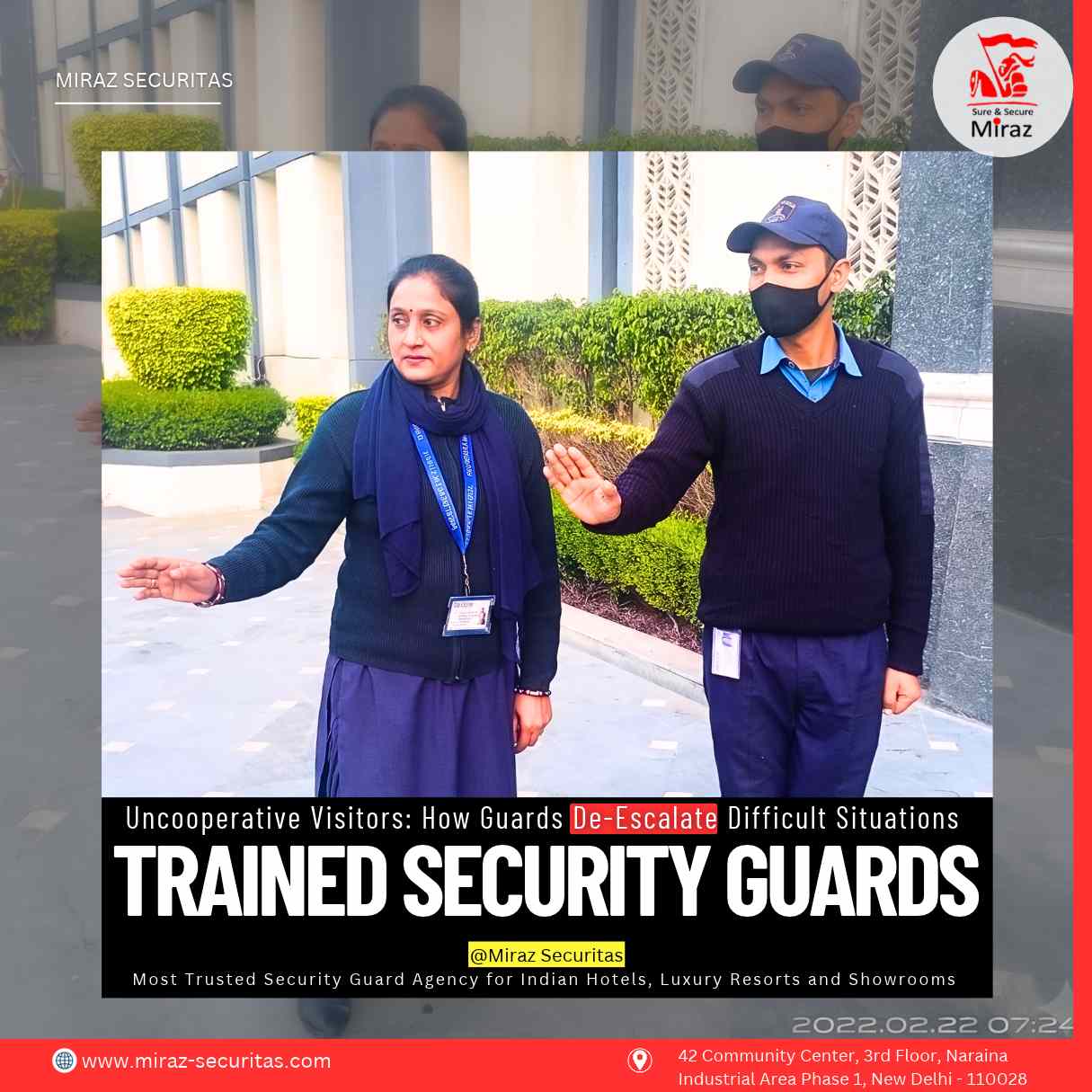
A visitor’s aggressive tone should not automatically provoke an equally aggressive response. Guards should maintain a composed posture, speak clearly and avoid shouting or using insulting language.
Non-verbal communication also matters. Maintaining an appropriate distance, keeping hands visible and avoiding intimidating gestures can help reduce tension.
A calm approach demonstrates authority without making the interaction unnecessarily confrontational.
- Listen Before Giving Instructions
Sometimes visitors become frustrated because they feel they are not being heard. Allowing them to explain their concern can help guards understand the reason behind the disagreement.
For example, a visitor may have an appointment but may not know that the host needs to confirm their arrival. Listening briefly before explaining the procedure can prevent misunderstandings.
However, listening does not mean compromising security requirements. Guards must remain within their assigned authority and follow the organisation’s access-control policy.
- Explain the Rules Clearly and Politely
Security instructions should be simple, direct and consistent. Instead of saying, “You cannot enter because I said so,” a guard can explain that entry requires identification or confirmation from the concerned department.
A polite explanation helps visitors understand that the procedure is part of the premises’ security arrangements rather than a personal decision.
Guards should avoid making exceptions based on pressure, familiarity or repeated demands unless authorized personnel approve them.
- Offer Practical Alternatives
When visitors cannot enter immediately, guards can suggest appropriate next steps. These may include contacting the host, waiting at the designated reception area, completing registration or speaking with the facility administrator.
Offering an alternative gives visitors a clear way forward without weakening security procedures.
For instance, if someone arrives without prior approval, the guard can request confirmation from the employee or resident they intend to meet.
- Recognize When to Involve a Supervisor
Not every situation should be handled independently. If a visitor repeatedly refuses instructions, becomes verbally abusive or attempts to force entry, the guard should inform the supervisor or designated security control room.
Escalation through the proper reporting channel ensures that difficult situations receive appropriate attention. It also prevents individual guards from making decisions beyond their authority.
What Should Guards Do When a Visitor Becomes Aggressive?
Verbal disagreement can sometimes develop into threatening behaviour. In such circumstances, protecting people becomes more important than continuing the conversation.
Guards should maintain a safe distance, avoid physical confrontation and keep a clear route for moving away if necessary. They should alert nearby security personnel or supervisors and follow the site’s emergency response procedures.
If a visitor attempts to enter a restricted area, damages property or threatens someone with violence, the incident should be treated according to its seriousness. Where there is an immediate threat, guards should contact the appropriate emergency services or police.
Physical intervention should never be used as punishment or to win an argument. Any intervention must be lawful, necessary, proportionate and consistent with training and organizational procedures.
Why Documentation and Reporting Matter?
Once a difficult interaction has been resolved, the incident should be documented according to the site’s reporting policy.
A useful incident report should include the date and time, location, nature of the disagreement, instructions given, actions taken, people involved and whether a supervisor or emergency service was contacted.
Reports should remain factual and avoid personal assumptions or exaggerated descriptions. CCTV footage and visitor register details may also help establish what happened, subject to the organisation’s privacy and evidence-handling procedures.
Accurate documentation helps management identify repeated access-control problems, review security procedures and arrange additional staff training when necessary.
How Can Security Companies Prepare Guards for Difficult Visitor Interactions?
Conflict management should be part of regular security training rather than something guards are expected to learn only through experience.
Training programmed can include communication skills, visitor verification, de-escalation techniques, emergency reporting, professional conduct and scenario-based exercises.
Supervisors should also ensure that guards understand the property’s access rules, escalation contacts and limits of their authority. Clear procedures reduce confusion, especially during busy periods when multiple visitors arrive simultaneously.
For organisations, having trained guards at entry points can improve visitor management while helping maintain a secure and welcoming environment.
Security Industry Perspective
“Professional security management is not measured only by how firmly rules are enforced, but also by how effectively difficult situations are controlled. A trained guard should be able to communicate clearly, maintain composure and recognise when a situation requires supervisory or emergency intervention.” Says Mr. Atul Mahajan, Director, Miraz Securitas a security guard services company for hospitals, shopping malls in Delhi, Gurugram aand NOIDA.
When visitors refuse to cooperate, the objective should be to resolve the situation without compromising safety or creating unnecessary confrontation. Calm communication, consistent access-control procedures, timely escalation and accurate reporting help security teams manage challenging interactions professionally.
FAQs on Security Services for Handling Difficult Visitors
1. How should a security guard respond when a visitor refuses to cooperate with entry procedures?
Guards should remain calm, maintain a composed and non-threatening posture, and avoid reacting emotionally or arguing. They should listen briefly to understand the visitor’s concern, then clearly and politely explain that entry rules are part of the facility’s standard security policy rather than a personal decision. When immediate entry is not possible, guards can offer practical next steps—such as contacting the host for confirmation, asking the visitor to wait at reception, or guiding them through registration—without making unauthorized exceptions.
2. What should guards do if a difficult visitor becomes verbally abusive or physically aggressive?
When a visitor’s behavior turns threatening, protecting people takes priority over continuing the conversation. Guards should keep a safe distance, ensure a clear path to step back, avoid physical confrontation, and immediately notify a supervisor, nearby security staff, or the control room. If the visitor attempts forced entry, damages property, or poses an immediate threat of violence, guards should follow emergency protocols and contact police or emergency services. Any physical intervention must strictly be lawful, necessary, proportionate, and aligned with organizational training and procedures.
3. Why is incident documentation important after a difficult visitor interaction, and what should it include?
Accurate documentation helps management identify recurring access-control issues, evaluate existing security procedures, and arrange additional staff training where needed. Reports should remain strictly factual—free of assumptions or exaggeration—and record the date and time, location, nature of the disagreement, instructions given, actions taken, individuals involved, and whether supervisors or emergency services were contacted. Visitor logs and CCTV footage may also be referenced in line with the organization’s privacy and evidence-handling policies.

Under the successful leadership of Mr. Mahajan, Miraz Securitas Pvt Ltd today has achieved an over 100% growth rate within half a decade time. His vision for upgrading private security service has helped Miraz Securitas established a footprint PAN India. Today Miraz ,a trusted name has clients , across all market segments such as top universities, private & international schools, prestigious institutions of government of India, retail establishment, & more.
In the year 2017, Miraz Securitas won the prestigious ‘MSE 4’ ratings by global rating & research organization – CRISIL & India’s Public Sector unit NSIC for accomplishing high-performance capability & above-average creditworthiness among other Indian companies.
- When Visitors Refuse to Cooperate: How Guards Handle Difficult Situations Without Escalating Conflict - November 23, 2026
- Security During Staff Shift Changes: Why Are These Few Minutes Often Overlooked? - November 18, 2026
- Why Security Guards Need Emergency Training, Not Just Site Instructions - November 9, 2026