Bank Security: Direct Answer Summary
- Security guards help protect banks by monitoring entrances, verifying visitors, and identifying suspicious activities.
- They support cash movement, ATM security, crowd management, and emergency response.
- Effective bank security combines trained personnel, access control, surveillance systems, and clearly defined safety procedures.
Banks and financial institutions handle cash, confidential documents, customer information, and valuable assets every day. Their premises also experience regular public movement, making them potential targets for theft, fraud, unauthorised access, and other security threats.
While CCTV cameras, alarms, and electronic access systems play an important role, trained security guards provide an essential human presence. They observe activities, manage entry points, respond to unusual situations, and help maintain a safe environment for employees and customers shares Miraz Securitas a trusted security guard company for banks in Delhi, Gurugram and NOIDA.
Why Do Banks Need Professional Security Guards?
Banks require security arrangements that address both everyday risks and unexpected emergencies. Unlike many commercial premises, they handle financial transactions, valuable assets, and sensitive customer information.
Professional security guards help discourage unauthorised activities through visible monitoring and controlled access. Their presence also reassures customers and employees while ensuring that security procedures are followed consistently.

However, bank security is not limited to preventing robberies. It also involves managing crowds, identifying suspicious behaviour, protecting restricted areas, and responding quickly when an incident occurs.
“Effective bank security begins with vigilance, but it depends on trained personnel, clear procedures, and coordinated action.” Says Mr. Atul Mahajan, Director of Miraz Securitas.
How Do Security Guards Control Access to Bank Premises?
Access control is one of the primary responsibilities of bank security personnel. Guards monitor entrances, observe visitors, and help prevent unauthorised individuals from entering restricted areas.
Their responsibilities may include:
- Monitoring customer and staff entry points.
- Verifying visitor credentials according to bank procedures.
- Directing visitors to designated service areas.
- Preventing unauthorised access to cash rooms, server rooms, and administrative sections.
- Reporting suspicious behaviour or unattended objects.
- Maintaining visitor and incident records where required.
A trained guard must remain alert without disrupting normal banking operations. Professional conduct, clear communication, and awareness of entry protocols are essential for maintaining both security and customer convenience.
What Role Do Guards Play in ATM and Cash Security?
ATMs and cash-handling operations require particular attention because they involve valuable assets and can attract criminal activity.
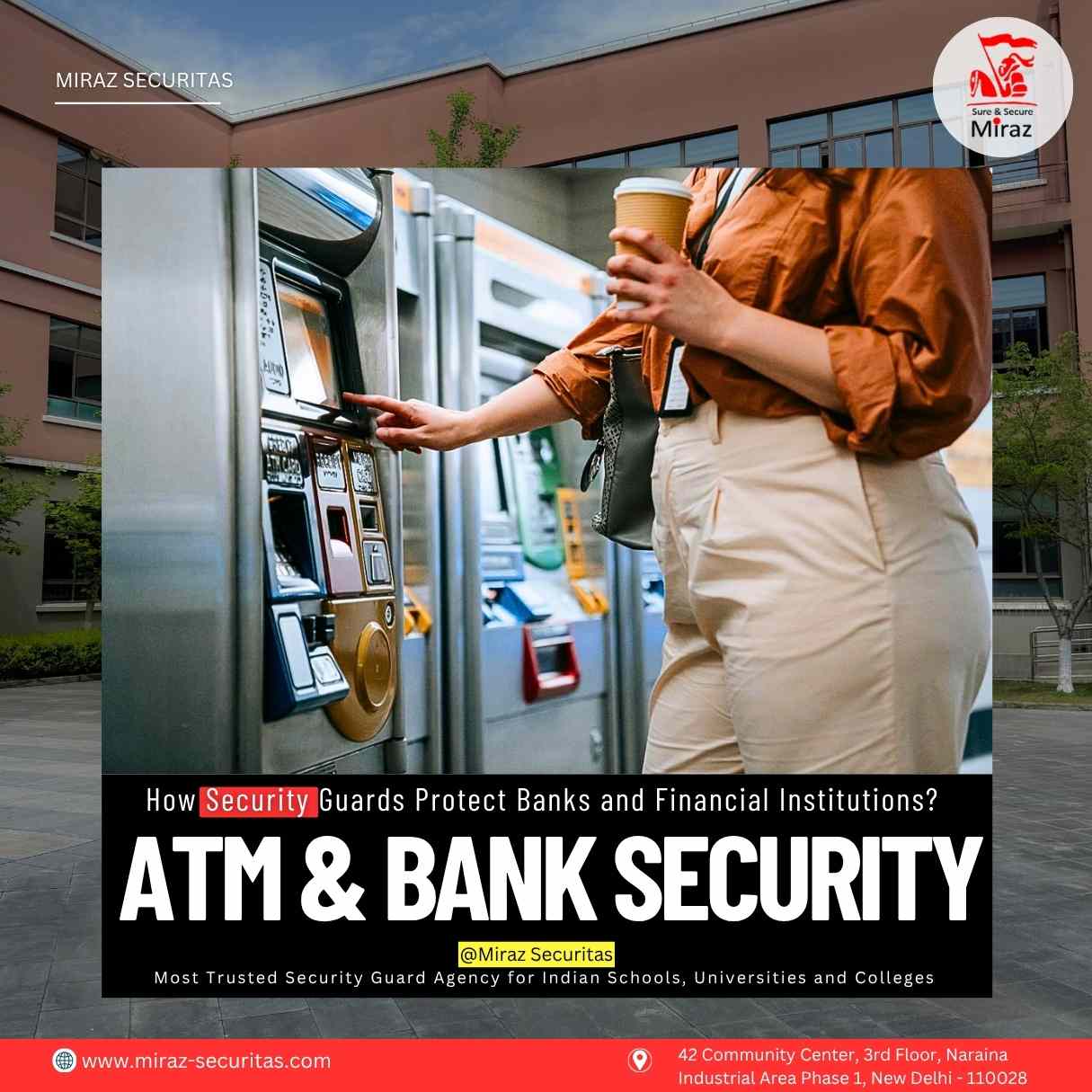
Security guards may be deployed at ATM locations to monitor customer movement, identify suspicious activity, and report signs of tampering or damage. They can also help maintain order around busy ATM facilities.
During cash transportation, authorized security personnel may support the movement of cash between designated locations. Their responsibilities depend on the assignment and applicable procedures, including coordination with authorized cash-in-transit teams.
Guards must follow established protocols rather than independently handling cash or attempting to confront suspected criminals.
How Do Security Guards Manage Crowds and Customer Safety?
Bank branches can become crowded during salary disbursements, pension payments, month-end transactions, and peak banking hours. Poor crowd management can lead to confusion, disputes, congestion, and security concerns.
Security guards help maintain orderly movement by guiding customers towards appropriate counters, managing queues, and keeping emergency exits accessible.
They also assist elderly customers and individuals who may require additional support while entering or moving through the premises.
Effective crowd management reduces unnecessary congestion and allows bank employees to focus on customer service and financial transactions.
How Do Security Guards Respond to Emergencies?
Banks must be prepared for situations such as attempted robbery, medical emergencies, fire incidents, suspicious packages, and aggressive behaviour.
Security guards serve as an important first point of response. Their training should help them recognize warning signs, alert the appropriate authorities, follow emergency procedures, and guide people towards safety.
Emergency situation | Security guard's responsibility |
Suspected robbery | Raise the alarm, follow bank emergency protocols, and avoid unnecessary confrontation. |
Fire or smoke | Alert occupants, activate emergency procedures, and assist with evacuation. |
Medical emergency | Inform emergency services and help provide access to assistance. |
Suspicious package | Keep people away, avoid touching the object, and notify the appropriate authorities. |
Aggressive behaviour | Maintain a safe distance, alert supervisors, and seek assistance when necessary. |
The objective is to protect lives, minimize risks, and ensure that emergency responders can carry out their duties effectively.
Why Is Professional Training Important for Bank Security Guards?
Working in a financial institution requires more than a uniform and a visible security presence. Guards must understand the responsibilities associated with protecting a sensitive commercial environment.
Training should cover access control, observation skills, communication, emergency response, customer interaction, incident reporting, and conflict de-escalation. Depending on the assignment, personnel may also require specialised training for cash movement, surveillance coordination, and other security responsibilities.
Regular briefings and emergency drills help guards remain familiar with site-specific procedures. Background verification, licensing requirements, supervision, and performance monitoring are equally important when selecting a professional security agency.
How Can Banks Strengthen Their Overall Security Arrangements?
Security works best when trained personnel operate alongside appropriate technology and well-defined procedures.
Banks can strengthen their security arrangements through controlled entry systems, CCTV monitoring, alarm systems, adequate lighting, secure cash-handling procedures, and regular security assessments.
Clear coordination between guards, branch managers, security supervisors, and local emergency services also helps improve preparedness.
Security deployment should be based on the branch’s location, customer footfall, operating hours, cash-handling requirements, and identified risk factors. A uniform security arrangement may not be suitable for every financial institution.
Security guards play an important role in protecting banks and financial institutions by controlling access, monitoring suspicious activities, supporting cash security, managing customer movement, and responding to emergencies.
However, effective protection requires more than simply deploying personnel at entrances. Banks need trained guards, clear operating procedures, appropriate technology, and continuous supervision.
A professional security arrangement helps create a safer environment for customers, employees, financial assets, and daily banking operations.
Essential Questions on Bank Security Guard Operations
Q: Are bank security guards expected or trained to physically confront armed robbers?
A: No. Bank security doctrine strictly prohibits direct physical confrontation with armed perpetrators. Life safety and silent alarm protocol always take precedence.
Details:
Standard Operating Procedures (SOP) across banking regulatory bodies prioritize human life above physical currency or bank property. Armed robbery situations carry extreme collateral risk for staff and customers.
Guards are trained to remain calm, avoid sudden aggressive motions that could trigger violence, cooperate with demands to de-escalate tension, and activate discrete silent alarms or duress codes only when it is safe to do so.
Their chief operational value during an active robbery is situational reconnaissance: memorizing the perpetrators’ physical characteristics (height, clothing, tattoos, distinctive marks, firearms used, direction of escape, and vehicle license plates) to furnish critical intelligence to law enforcement.
Key Takeaway: The primary mission is preserving human life through de-escalation and intelligence gathering, not armed heroics.
Q: What is the key difference between electronic security systems (CCTV, alarms) and stationed security guards in banks?
A: Electronic systems provide passive monitoring and forensic evidence, whereas security guards provide dynamic human deterrence, active triage, and proactive judgment.
Details:
CCTV cameras and electronic alarms are passive sensors—they record incidents for post-event forensic investigations or sound alarms once a threshold is breached. They cannot actively question a suspicious visitor or assist an elderly customer in distress.
Security guards provide an immediate psychological deterrence that prevents crime before it starts. Criminals scout bank branches and frequently avoid branches with vigilant, disciplined guard presence.
Guards bridge human judgment with technology: they verify visitor badges, interpret anomalies (such as loiterers studying camera angles or ATM tampering), manage panic during fire alarms, and secure physical barriers during cash replenishment.
Key Takeaway: Technology records the crime; trained guards deter the criminal and manage the real-time physical space.
Q: How do security guards secure on-site and off-site ATMs against fraud, skimming, and vandalism?
A: Guards inspect ATM exteriors for skimming overlays, maintain customer spacing for PIN privacy, and report tampering or suspicious vestibule loitering.
Details:
Physical inspection sweeps: Guards are trained to perform scheduled tactile checks on ATM card slots, keypads, and bezels to detect skimming hardware, hidden pinhole micro-cameras, or glue traps.
Customer privacy and anti-shoulder surfing: In busy branch vestibules, guards establish orderly waiting distances behind floor lines so patrons can enter PINs without exposure.
Combating evening loitering and vandalism: Especially at standalone or 24/7 ATM kiosks, guards deter vagrancy, maintain clear vestibule lighting, ensure emergency call buttons function, and immediately report uncollected cash or machine error codes.
Key Takeaway: Daily physical tamper inspections and maintaining an uncrowded ATM zone block over 80% of ATM skimming and smash-and-grab attacks.
Q: What legal authority does a private bank security guard have regarding bag searches and detaining suspects?
A: Guards have property access control authority to condition entry upon consensual bag inspection, but they do not hold sworn police arrest powers.
Details:
Conditional Entry Authority: As bank premises are private property open to the public for specific commercial purposes, guards can require baggage checks or metal detector scans as a condition of entry. If a visitor refuses, the guard has full legal authority to deny entrance.
Detention & Citizen’s Powers: Security guards cannot arrest or interrogate citizens as police officers do. In cases of active violent felonies (e.g., weapon brandishing or assault), guards may exercise citizen’s detention—holding the suspect with proportional, reasonable restraint until law enforcement arrives.
Evidence Preservation: Guards must isolate crime scenes, restrict public access to areas with latent fingerprints or dropped items, and refrain from touching physical evidence until forensics personnel take over.
Key Takeaway: Guards enforce bank entry policies by consent or denial of entry; police execute formal criminal detainment and searches.
Q: How do bank security guards coordinate during Cash-In-Transit (CIT) vehicle arrivals and vault transfers?
A: Guards establish an uncompromised sterile corridor between the armored vehicle and the vault room, holding back the public while CIT custodians move bullion and cash.
Details:
Establishing the Sterile Corridor: Prior to armored vehicle docking, stationed guards clear the unloading perimeter, verify that curbside parking is reserved exclusively for the armored transport, and monitor bystanders.
Credentials Verification & Communication: Guards cross-check the identity badges, authorization slips, and arrival manifests of armored vehicle personnel before unlocking security bay gates or auxiliary entry doors.
Strict Separation of Duties: Stationary guards do NOT physically load or handle the cash sacks or bullion crates themselves; their sole mission is 360-degree perimeter surveillance, weapon readiness (if armed post), and keeping pedestrians away.
Vault Lockdown: The inner vault zone remains access-restricted with dual-custody protocols during the entire replenishment process.
Key Takeaway: Bank guards provide outward perimeter protection while CIT personnel handle the cargo, preventing distraction or collusion.

Under the successful leadership of Mr. Mahajan, Miraz Securitas Pvt Ltd today has achieved an over 100% growth rate within half a decade time. His vision for upgrading private security service has helped Miraz Securitas established a footprint PAN India. Today Miraz ,a trusted name has clients , across all market segments such as top universities, private & international schools, prestigious institutions of government of India, retail establishment, & more.
In the year 2017, Miraz Securitas won the prestigious ‘MSE 4’ ratings by global rating & research organization – CRISIL & India’s Public Sector unit NSIC for accomplishing high-performance capability & above-average creditworthiness among other Indian companies.
- How Security Guards Protect Banks and Financial Institutions? - October 31, 2026
- How Schools Should Prepare Security Teams for an Unidentified Threat - October 26, 2026
- Why Soft Skills is More Powerful than Gun in Modern Elite Security? - October 21, 2026