
Site Security: Direct Answer Summary
- Site instructions and emergency training serve different purposes: Routine instructions explain daily duties, while emergency training prepares guards to respond to unpredictable incidents.
- Practical training improves emergency readiness: Fire drills, first-aid demonstrations, evacuation exercises, and scenario-based training help guards respond more effectively.
- Security agencies and clients share responsibility: Both must ensure that guards understand site-specific risks, emergency procedures, communication protocols, and their respective responsibilities.
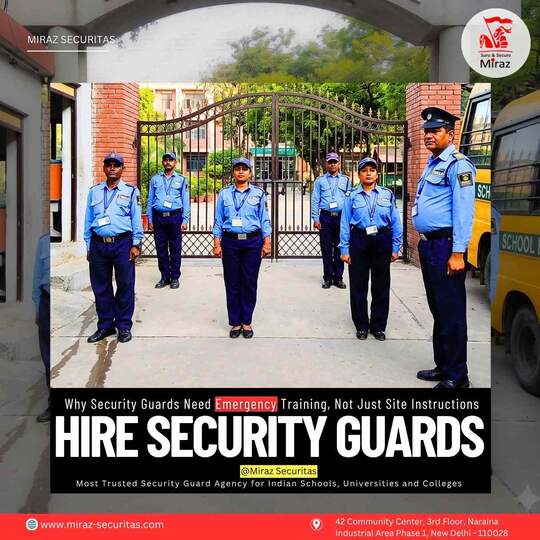
Security guards are often the first people expected to respond when an emergency occurs at a commercial building, hospital, residential complex, office, or industrial facility. Whether it is a fire, medical emergency, security breach, violent confrontation, or sudden crowd disturbance, their initial response can significantly influence how the situation develops. However, simply assigning guards to a site and explaining their daily duties does not adequately prepare them for unexpected incidents.
Site instructions help security personnel understand their routine responsibilities, such as monitoring entry points, checking visitor credentials, maintaining registers, and conducting patrols. Emergency training, on the other hand, prepares them to make decisions under pressure, communicate effectively, protect people, and follow established response procedures. Both are essential, but they serve different purposes shares Miraz Securitas a trusted security guard agency in Delhi, Gurugram and NOIDA.
Why Are Site Instructions Not Enough During an Emergency?
Site instructions are generally designed to maintain routine security operations. They explain where guards should be stationed, which areas require monitoring, whom to contact, and how to manage visitors or deliveries.
However, emergencies rarely follow predictable routines. A guard who knows how to operate an entrance gate may not necessarily know how to respond when a vehicle catches fire nearby or an individual suddenly collapses.
Without practical emergency training, security personnel may hesitate, panic, make incorrect decisions, or fail to communicate critical information.
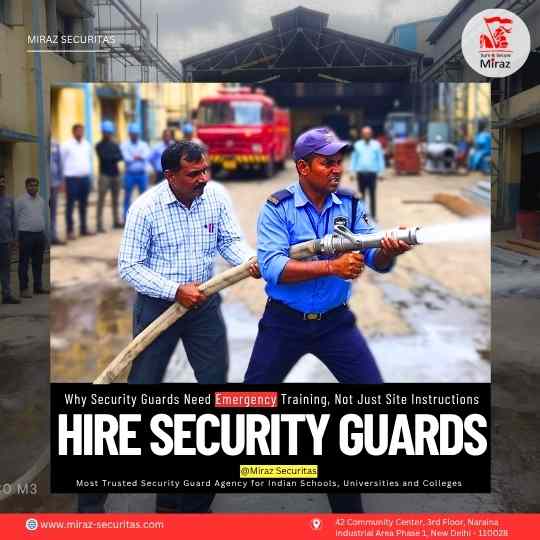
For example, during a fire emergency, a guard must know how to raise an alarm, guide occupants towards designated exits, prevent people from entering unsafe areas, and coordinate with emergency responders. These responsibilities require preparation beyond routine site instructions.
“Security instructions explain what guards must do every day, but emergency training prepares them for the situations that can change everything in a matter of seconds.” Says Mr. Atul Mahajan, Director of Miraz Securitas.
What Emergency Situations Should Security Guards Be Trained to Handle?
Security guards should receive training based on the risks associated with their assigned locations. While requirements vary across facilities, certain emergency response capabilities are relevant to most security deployments.
These include:
- Fire Emergencies: Recognizing fire hazards, raising alarms, understanding evacuation procedures, and using fire extinguishers when trained and safe to do so.
- Medical Emergencies: Recognizing warning signs, contacting emergency medical services, and providing basic first aid or CPR within their training.
- Unauthorised Access and Security Breaches: Responding to suspicious individuals, controlling access, reporting threats, and following escalation protocols.
- Crowd Disturbances: Managing congestion, preventing panic, maintaining safe movement, and communicating with the designated response team.
- Violent or Aggressive Behaviour: Maintaining a safe distance, using de-escalation techniques, protecting bystanders, and seeking appropriate assistance.
- Natural Disasters: Following evacuation or shelter-in-place procedures during earthquakes, severe weather, or other site-specific hazards.
The objective is not to turn every security guard into an emergency specialist. It is to ensure that personnel understand their role and can take appropriate initial action until specialised responders arrive.
How Does Emergency Training Improve a Security Guard’s Response?
Emergency training develops the ability to translate instructions into practical action. It helps security personnel understand what to do, whom to inform, and which actions to avoid when an incident occurs.
Practical exercises are particularly important because emergencies often involve confusion, noise, time pressure, and multiple people requiring assistance.
For instance, a guard who has participated in a fire evacuation drill is more likely to understand the location of emergency exits, assembly points, alarm systems, and communication channels.
Training also improves coordination between security guards, facility managers, housekeeping teams, maintenance personnel, and emergency services.
A structured training programme should include:
- Practical demonstrations: Familiarizing guards with emergency equipment, alarms, communication devices, and evacuation routes.
- Scenario-based exercises: Simulating incidents such as fire outbreaks, medical emergencies, and unauthorised entry.
- Communication training: Teaching personnel how to relay accurate information without creating unnecessary panic.
- Refresher sessions: Reinforcing emergency procedures and addressing gaps identified during drills.
- Performance evaluation: Assessing whether guards can follow procedures and respond appropriately during simulated situations.
Who Is Responsible for Ensuring Security Guards Receive Emergency Training?
Responsibility generally lies with the security service provider, supported by the client organisation’s site management team.
The security agency must ensure that deployed personnel receive appropriate induction, role-specific training, and emergency response guidance. It should also assess whether guards understand the procedures applicable to their assigned locations.
The client organisation, meanwhile, should communicate site-specific risks, provide access to relevant emergency plans, identify assembly points, and coordinate emergency drills with the security agency.
Both parties must ensure that guards understand their responsibilities during an incident rather than assuming that general security experience is sufficient.
Training Area | What Guards Learn | Expected Outcome |
Fire Safety | Alarm, evacuation and fire response | Safer emergency evacuation |
First Aid | Basic emergency assistance | Faster initial medical response |
Security Breaches | Threat identification and escalation | Faster initial medical response |
What Can Happen When Security Guards Are Not Properly Trained?
The absence of emergency training can create serious operational weaknesses. A delayed alarm, incorrect evacuation direction, poor communication, or failure to secure a restricted area can increase the risks associated with an incident.
In hospitals, for example, an untrained guard may struggle to manage an emergency crowd while ensuring that ambulance access remains clear. In commercial buildings, confusion during evacuation can lead to congestion around staircases and exits. At industrial facilities, failure to follow emergency protocols can expose employees and visitors to additional hazards.
These situations demonstrate why security performance should not be measured only by attendance, gate management, or patrol completion. The ability to respond appropriately during an emergency is equally important.
As TFTS (Trendsetters Facilities & Technical Services Pvt. Ltd.) recognizes, effective security management requires trained personnel who understand both their routine duties and their responsibilities during unexpected situations. A well-prepared security workforce contributes to safer facilities through preventive vigilance, effective communication, and coordinated emergency response.
Frequently Asked Questions
1. How often should security guards receive emergency training?
Security guards should receive emergency training during initial deployment, followed by periodic refresher sessions and practical drills. Additional training may be necessary when site conditions, security risks, or emergency procedures change.
2. Is emergency training mandatory for all security guards?
Security personnel must receive training appropriate to their roles and applicable regulatory requirements. The Private Security Agencies (Regulation) Act (PSARA) and its associated rules establish training requirements for private security personnel in India. Site-specific emergency training further prepares guards for actual workplace risks.
3. What is the difference between security training and emergency response training?
Security training covers routine responsibilities such as access control, visitor management, surveillance, and patrolling. Emergency response training focuses on handling incidents such as fires, medical emergencies, security breaches, evacuations, and crowd disturbances. Both are essential for effective security operations.

Under the successful leadership of Mr. Mahajan, Miraz Securitas Pvt Ltd today has achieved an over 100% growth rate within half a decade time. His vision for upgrading private security service has helped Miraz Securitas established a footprint PAN India. Today Miraz ,a trusted name has clients , across all market segments such as top universities, private & international schools, prestigious institutions of government of India, retail establishment, & more.
In the year 2017, Miraz Securitas won the prestigious ‘MSE 4’ ratings by global rating & research organization – CRISIL & India’s Public Sector unit NSIC for accomplishing high-performance capability & above-average creditworthiness among other Indian companies.
- Why Security Guards Need Emergency Training, Not Just Site Instructions - November 9, 2026
- How Security Guards Protect Banks and Financial Institutions? - October 31, 2026
- How Schools Should Prepare Security Teams for an Unidentified Threat - October 26, 2026