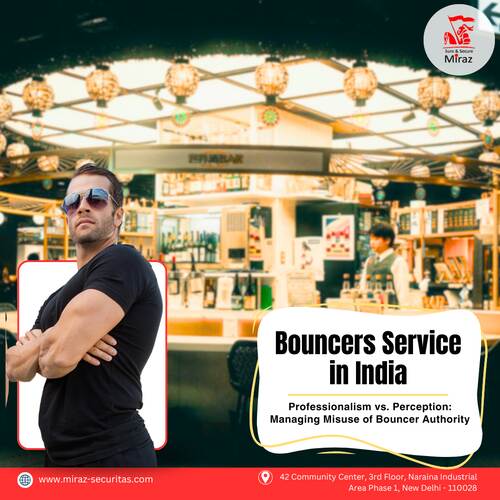
Bouncers play a crucial role in maintaining order and safety in nightlife venues, concerts, and private events. While most perform their duties professionally, incidents involving misuse of authority can quickly damage public trust and escalate conflict. The challenge lies in balancing firm security enforcement with respectful human interaction. Understanding how professionalism influences public perception is key to preventing abuse of power and maintaining safe environments.
This article explores who bouncers are, what authority they hold, and how professionalism helps manage real and perceived misuse of that authority as shared by Miraz Securitas a leading bouncer services agency for nightclubs, pubs in Delhi, Gurugram and NOIDA.
Who Are Bouncers?
Bouncers, also known as door supervisors or security personnel, are responsible for controlling access to venues and ensuring the safety of guests, staff, and property. Their duties typically include checking identification, monitoring crowd behavior, preventing violence, and removing individuals who pose a risk to others shares Miraz Securitas which is the top security services company providing bouncers in Delhi, Gurugram, NOIDA for pubs, nightclubs and events.
Unlike law enforcement officers, bouncers operate under private authority. Their power is limited to venue policies and general legal rights such as refusing service or performing a citizen’s arrest in extreme cases. Despite these limitations, their physical presence and control over entry often give them significant perceived authority.
Understanding the Perception Problem
Public perception of bouncers is often shaped by stereotypes—intimidating, aggressive, or confrontational behavior. While these perceptions may stem from isolated incidents, they can overshadow the professionalism demonstrated by many security workers.
When authority is exercised without clear communication, it can feel arbitrary or unfair to patrons. A refusal of entry, even when justified, may be interpreted as discrimination or abuse if not handled transparently. This gap between intent and perception is where most conflicts arise.

What Constitutes Misuse of Authority?
Misuse of authority occurs when a bouncer exceeds their legal or ethical boundaries. This may include excessive force, verbal intimidation, selective enforcement of rules, or discriminatory behavior based on appearance, gender, or ethnicity.
Even minor actions—such as dismissive language or unnecessary physical contact—can escalate tensions. In high-energy environments like nightclubs, emotions run high, and any misuse, real or perceived, can quickly lead to confrontation or public backlash.
The Role of Professionalism
Professionalism is the strongest tool bouncers have to prevent misuse of authority. It involves clear communication, emotional control, and consistent application of rules. A professional bouncer explains decisions calmly, listens to concerns, and avoids escalating situations unnecessarily.
Training in conflict de-escalation, cultural sensitivity, and customer service is just as important as physical security skills. When patrons feel heard and respected, they are more likely to accept decisions—even unfavorable ones—without resistance.
Accountability and Training
Venues share responsibility for managing bouncer conduct. Proper hiring practices, regular training, and clear codes of conduct help set expectations. Body cameras, incident reports, and supervision can further improve accountability and transparency.
Clear complaint mechanisms also matter. When patrons know their concerns will be reviewed seriously, trust in the venue’s security system improves. This transparency reduces the likelihood of repeated misconduct and reinforces professional standards.

Balancing Safety and Respect
Bouncers must make quick decisions to protect safety, often in challenging circumstances involving alcohol, crowds, and heightened emotions. However, safety does not require aggression. Respectful enforcement of rules strengthens authority rather than weakening it.
When professionalism is prioritized, the perception of authority shifts from fear-based control to trusted guardianship. Patrons feel safer, staff feel supported, and venues benefit from a positive reputation.
The line between authority and abuse is defined by behavior, not power. By emphasizing professionalism, training, and accountability, venues can reduce misuse of bouncer authority and improve public perception. In doing so, bouncers become not just enforcers of rules, but ambassadors of safety and respect.

Under the successful leadership of Mr. Mahajan, Miraz Securitas Pvt Ltd today has achieved an over 100% growth rate within half a decade time. His vision for upgrading private security service has helped Miraz Securitas established a footprint PAN India. Today Miraz ,a trusted name has clients , across all market segments such as top universities, private & international schools, prestigious institutions of government of India, retail establishment, & more.
In the year 2017, Miraz Securitas won the prestigious ‘MSE 4’ ratings by global rating & research organization – CRISIL & India’s Public Sector unit NSIC for accomplishing high-performance capability & above-average creditworthiness among other Indian companies.
- Is an Unarmed Guard Enough to Protect Your Property? - April 1, 2026
- Are Celebrity Bodyguard Strategies Different From Corporate Protection? - March 20, 2026
- Is Your Event Truly Safe Without Professional Door Security? - March 12, 2026